
Builders vs. Scalers
Why Your First GTM Hire Fails


Introduction
Not all great players are the same.
Some define the game.
Some thrive once the game is defined.
Think about Steve Yzerman, who led the Detroit Red Wings dynasty in the late 90s and early 2000s.
Yzerman was a complete player. Two-way game, leadership, structure. He could adapt to whatever the team needed and helped define how those teams actually worked.
That’s a builder.
Then you have someone like Pavel Bure, in his prime on those early 90s Canucks teams. Pure speed. Pure scorer. Put him in space and he’s lethal.
But drop him into a broken system, and talent alone won't save him.
That’s a scaler. Elite talent still needs the right system.
Maturing teams don’t need pure scorers first.
They need players who can shape the game.
Where This Shows Up in GTM
The same dynamic shows up in early GTM teams all the time.
Founders sell the first few million themselves. It’s messy, relationship-driven, and deeply tied to the product. Lead gen comes through hustle, network, and proximity to the customer. Nothing is really repeatable yet, but it works.
They’re effectively playing the builder role, whether they realize it or not.
Then, it’s time to hire. And this is where things start to break.
They find someone with a strong track record. Big logos. Consistent quota attainment. Polished. On paper, exactly what you’d want.
Three months later, it’s not working. Pipeline is thin. Deals stall. Everything feels harder than it should.
The instinct is to think they hired the wrong person. Usually they didn’t.
They hired the right person for the wrong phase of the business.
Two Profiles, One Mistake
There are two very different profiles in early GTM, even though they often get treated as the same job: builders and scalers.
Builders
A builder is what you need when you’re still figuring out where you win. You have a product and maybe a few customers, but nothing really repeats yet. Your ICP is still a moving target, and your messaging shifts depending on the conversation.
A builder operates well in that environment. They don’t just run deals, they run discovery on the market itself. They sit close to the customer, ask better questions, and come back with signal that shapes both the sale and the product. The best ones are full-cycle and comfortable in ambiguity.
They’re not just selling. They’re helping the company learn where it wins.
Scalers
A scaler is different. They thrive when the motion already exists. When the ICP is clear, messaging is tight, and the process is defined, scalers are incredibly effective. They are built to run a system.
But if that system doesn’t exist yet, things break quickly. A scaler without a motion is like a Formula 1 car on a dirt road. The capability is real, but the environment doesn’t support it.
The Framework
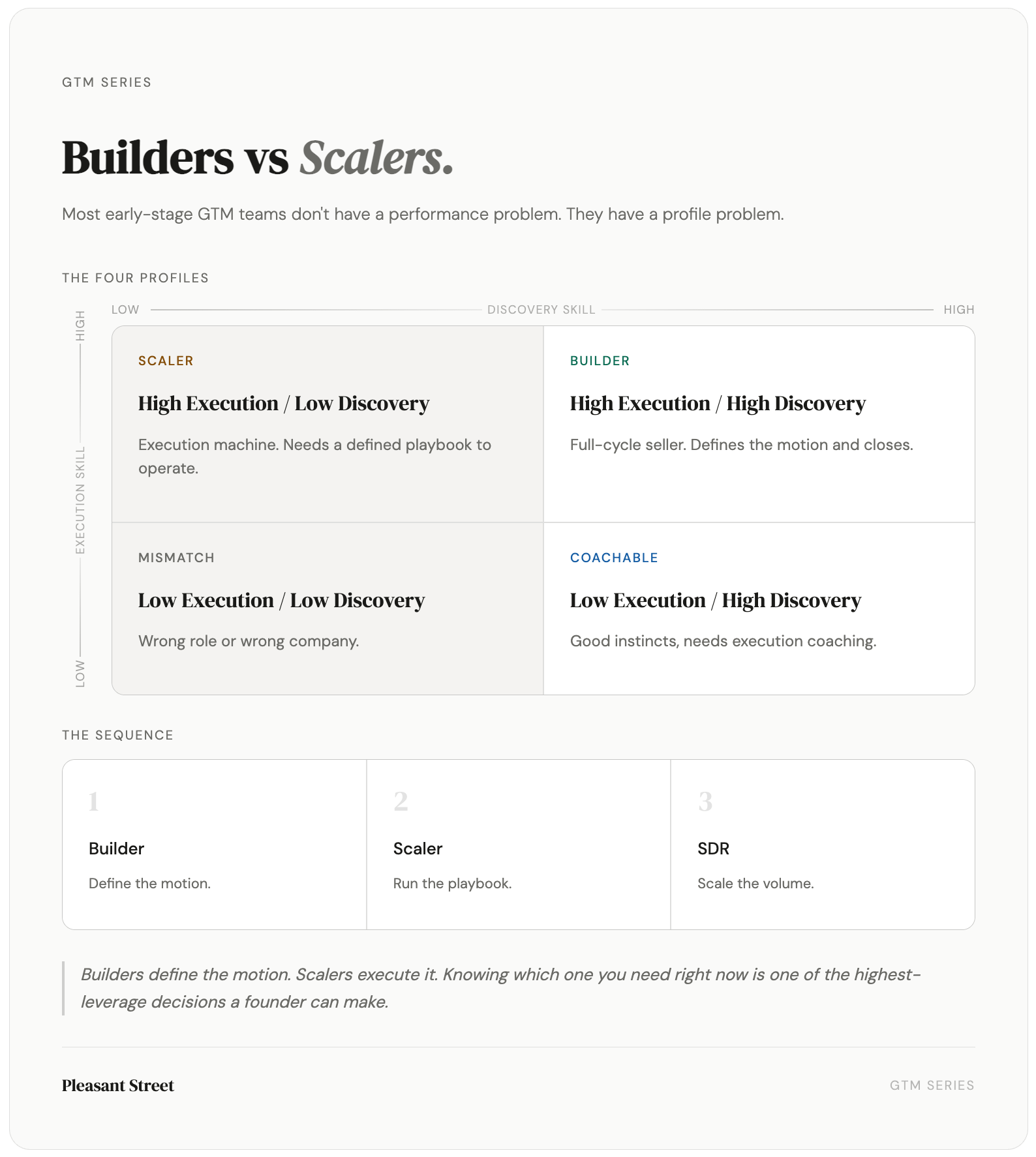
The way I think about it is simple. Two things matter early on: can someone figure out what works, and can they execute once they find it.
The people who can do both are your builders. High discovery, high execution. These are the people who define the motion and close within it.
High execution but low discovery tends to be your scalers. They are strong operators once something is defined, but they rely on a working playbook.
Some people sit in between and can be developed. Some are just mismatched.
Most early teams are light on builders and heavy on scalers. Or they have scalers trying to survive in builder roles, which usually shows up as underperformance that’s hard to explain.
Two Critical Missteps
There are two places in this model where things tend to break.
Hiring Scalers Too Early
Founders tend to hire scalers too early. Not because it’s irrational, but because it looks right. Big logos. Clean quota numbers. A clear story.
Builders don’t always present that way. Their backgrounds are messier, with more variation and experimentation. Harder to neatly explain.
But in an early market, that messiness is the job.
Skipping the Sequence
The second break is in how teams sequence GTM hires.
There’s a natural order to how revenue systems actually develop, even if it doesn’t feel like it in the moment. First comes the builder. The job is to define the motion, to figure out where you win, what resonates, and why deals close.
Then something starts to shift.
Wins begin to look similar. The same types of customers show up. Objections repeat. The path from first call to close starts to tighten. You’re not guessing anymore. You’re starting to see patterns.
That’s when the motion begins to exist. That’s when scalers become powerful. Only after that does it make sense to add SDRs and start pushing volume.
Most teams compress this. They try to jump straight to scale before the motion is real. Add structure, add people, add activity.
That’s when things feel broken.
The Takeaway
Early revenue isn’t just about hiring good sellers. It’s about matching the profile to where the company actually is.
Builders define the motion.
Scalers run it.
SDRs scale it.
Most teams don’t have a sales problem.
They’re just asking the wrong profile to do the job.
If this resonated, subscribe to follow along as I break down how early revenue systems actually work.
Ben from Dwellir (probably builder)
would love to connect about Flipside
great article