
The Sales-Product Pendulum
How to Turn Customer Signal into Growth

Introduction
Sales and product don’t usually break all at once. They drift.
At some point, without anyone really deciding it, product starts building in one direction and sales starts selling in another. Both teams are doing their job. Neither feels obviously wrong. But something stops clicking.
Most teams try to fix this with better communication. But, that’s not really the issue.
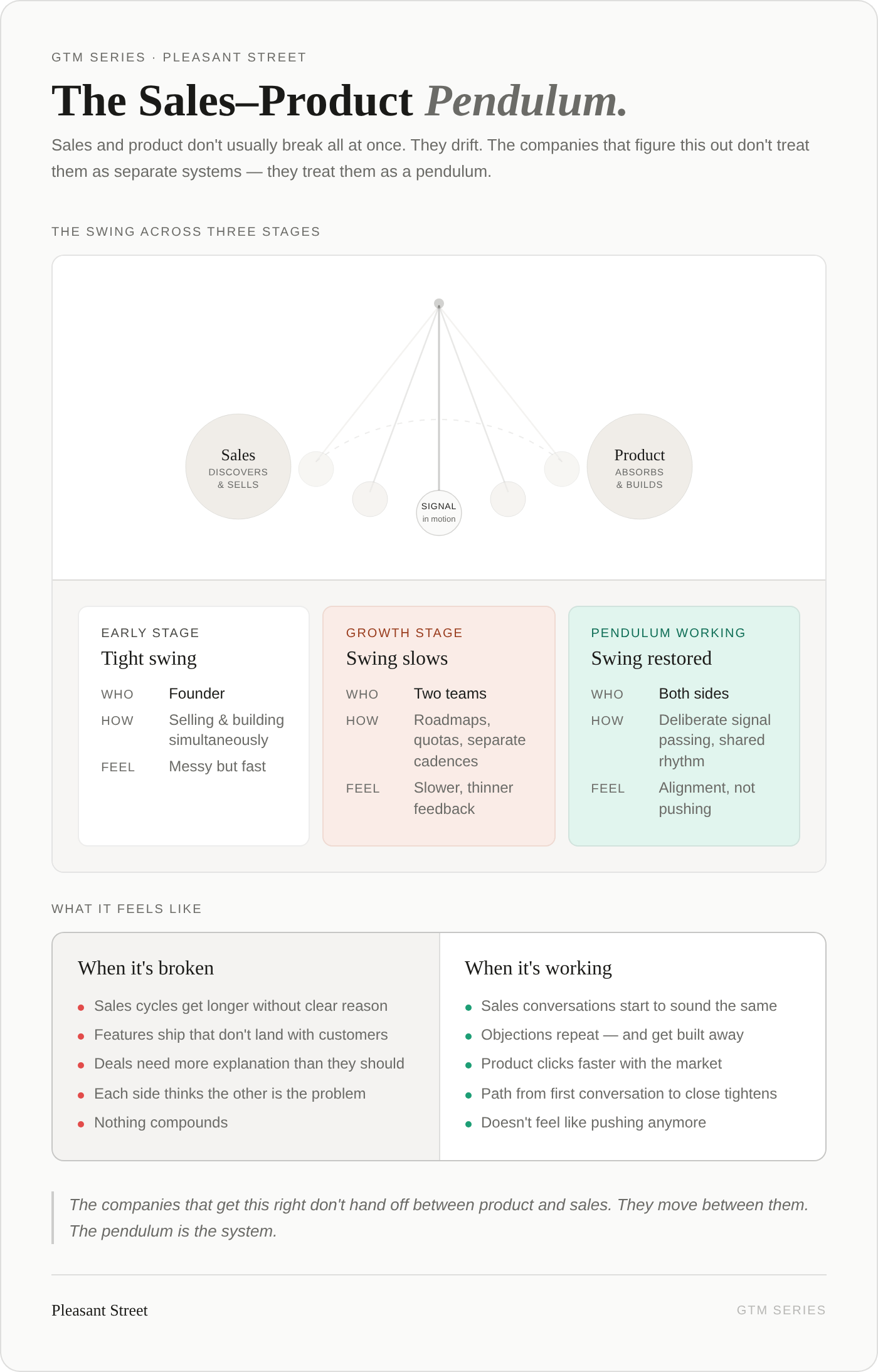
The companies that figure it out do something different. They build a system that keeps the two functions connected. Sales goes out, learns what the market actually wants, and brings that signal back. Product absorbs it, builds, refines, and then sales goes back out again.
Back and forth. Like a pendulum.
Early, It’s a Tight Swing
Early on, everything is tightly coupled.
The founder is the sales team. They’re talking to customers constantly, hearing objections in real time, adjusting the story mid-conversation, and pulling that insight straight back into the product. It’s messy, but it works.
Sales and product aren’t separate functions yet. They’re the same loop. Find the problem, build toward it, go back out.
Then, the Swing Slows
As the company grows, things start to separate.
Product gets more structured. Roadmaps, sprints, dependencies. Coordination shifts toward engineering and internal execution. Sales becomes a team. Quotas, pipeline, process.
And without anyone explicitly deciding it, the loop weakens.
Product starts building based on internal logic. Sales starts selling what exists. The feedback between them becomes slower, thinner, less useful. This is where things start to feel off.
You see products that make sense internally but don’t quite land with customers. Sales cycles get longer. Messaging drifts. Deals require more explanation than they should.
I’ve seen teams spend months building features that made perfect sense internally, while sales was losing deals over things that never made the roadmap.
Nothing is obviously broken. But nothing compounds either.
When the Pendulum Works
The companies that figure this out don’t treat product and sales as separate systems.
They treat them as a pendulum.
Sales goes out first, not just to close deals, but to discover. What are people actually trying to solve? What language do they use? Where does the product resonate, and where does it fall flat?
That signal comes back. Product absorbs it, refines, builds with a clearer understanding of what actually matters. Then sales goes back out again, sharper, more aligned, closer to something that fits.
Back and forth. That’s the system.
What most teams miss is that this doesn’t happen on its own. As companies grow, the default is separation. Product optimizes for building. Sales optimizes for closing. The loop breaks unless you actively design for it.
The companies that get this right don’t just rely on communication. They put structure around the feedback. It requires process and discipline. Clear signal from sales into product. Fast iteration. A shared understanding of what’s actually landing with customers.
Alignment isn’t a mindset. It’s a system.
The Feel of Alignment
When It’s Working
When the pendulum is working, you can feel it.
Sales conversations start to sound the same. Objections repeat. The product starts to click faster. The path from first conversation to close tightens. It doesn’t feel like pushing anymore. It feels like alignment.
When It’s Not
When it’s not working, you feel that too.
Sales is fighting uphill. Product is shipping things that don’t quite land. Each side starts to think the other is the problem. But it’s not either function. It’s the absence of the loop.
Customer-led product development sounds obvious. In practice, it’s not.
Sales has to do real discovery, not just run a script. Product has to stay close enough to the market to interpret signal, not just prioritize a backlog. Both sides have to be willing to adjust. That’s harder than it sounds.
Final Thought
The companies that get this right don’t hand off between product and sales. They move between them.
The pendulum is the system. And the companies that win are the ones that build for it.